Some of the scariest and deadliest hazards we come across in swiftwater are strainers. A strainer can be anything that lets water pass through, but prevents the passage of a person. I’ve seen strainers in the form of gates, cars, ropes, and fences. More commonly, strainers are cuased by downed trees or logs in river channels. A stainer can entrap a person very easily. It doesn’t take much current to grab and submerge a swimmer. The sub-surface of a strainer is the most dangerous part. Its what you can’t see that could end up entraping you. Scary as they are, strainers are avoidable, and prevention is the key!
Know before you go! Check available resources before putting on a river for a run. Often times good beta exists detailing the existence and whereabouts of strainers. For western boaters boof.com and other sites can be good starting points. Also, the agency mangaging the river section will sometimes alert boaters of known hazards. Commercial outfitters usually have a good handle on the section of river that they take paying guests down. Do a little work on the front end to save a lot of work on the tail end. If you find a strainer on a run, let people know; spread the word and help prevent an accident.
Strainer Strategy: AVOID
If you are in your boat or craft approaching a strainer try to get to shore above it and scout, or navigate around the obstacle. That is often easier said than done. In your craft you have more control and manuverability. If you find yourself swimming toward a strainer downstream, do your best Michael Phelps impression and get around it or get to shore. Aggressively work to swim around the strainer. Don’t give up! From water level strainers can be hard to spot. Look for branches or limbs breaking the surface, tree trunks or stumps on shore, and the fateful horizon line.
Can’t get around it…must go over it.
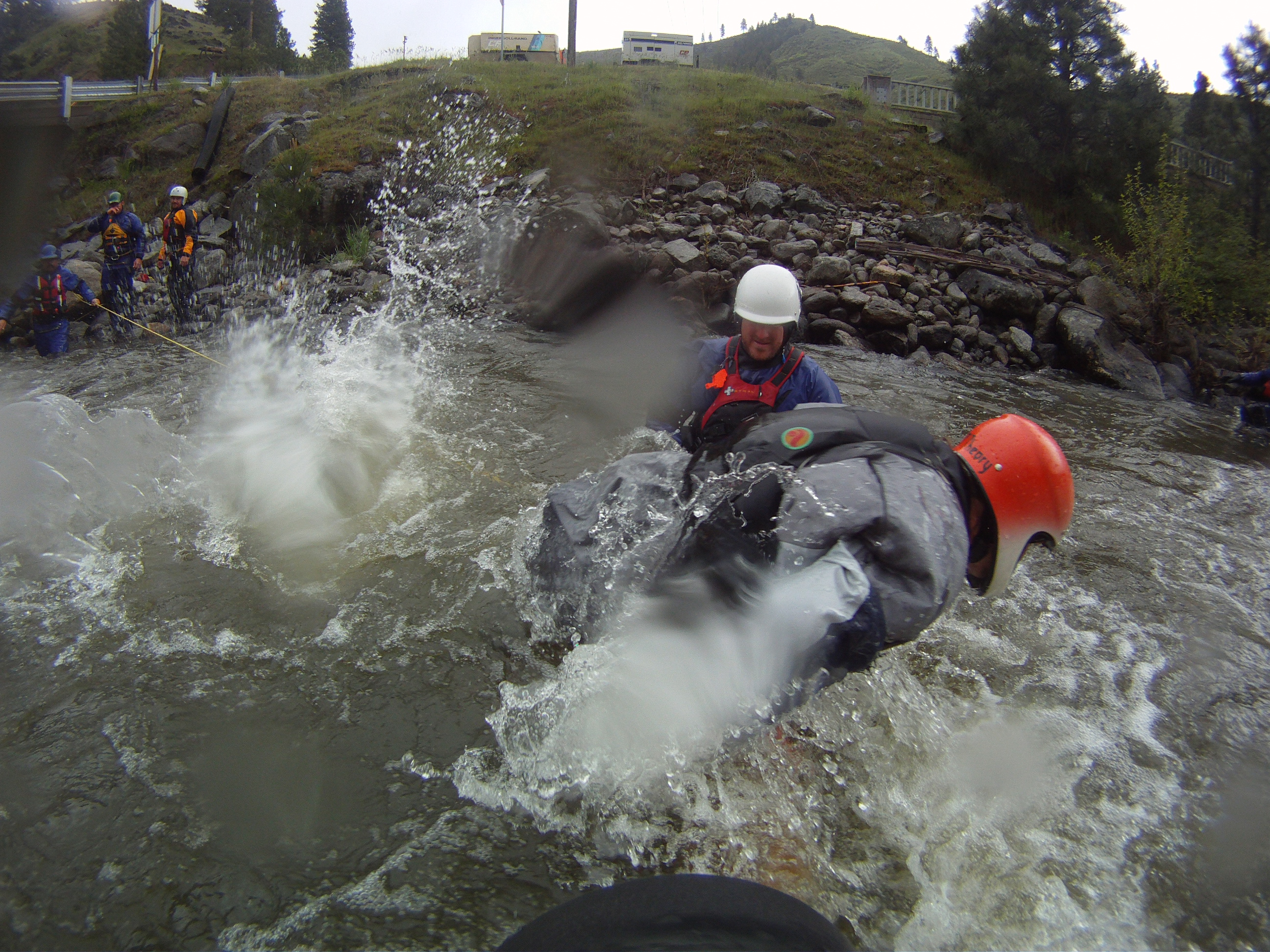 There are times when, as a swimmer, you can’t get around the strainer. In our classes we teach the following method for getting over a strainer. Face downstream on your belly and swim toward the strainer. Try to gain more speed than the water in which you are travelling. The idea is to get momentum, and vault over the strainer. Keeping your feet on the surface is key, as it is usually your legs that will get sucked under and hold you. Time your strokes so that as you approach the strainer (at the lowest, cleanest spot), you are able to reach out, arms extended, and grab the obstacle. Pull your hands to your waist as you propel your torso up on and over the obstacle. Then a quick and powerful kick will help you up and over the strainer. If the strainer is too large to crest, reach as high up as you can, hold your self there, and maintain your airway.
Strainer Rescue
From a rescue standpoint strainers present a difficult problem. Working upstream of a strainer opens the door for you and your team to be in same spot as the victim. Approaching from the side or downstream of the hazard is preferred. Getting hands-on stable and helping the victim to maintain his or her airway is key. Access and extraction from the downstream side reduces the risk to you and your team. Entrapment rope techniques can be used from shore upstream of the strainer to extract, but realize that any failure to coordinate extraction effectively will result in the victim back in the strainer with ropes.
Strainer Trainer
 Swimming through a strainer simulation can be a helpful tool to understand the force of current and the dire position you would find yourself in, if you were pinned on the upstream side of a strainer. In a controlled environment strainer drills are useful for perfecting the timing of the grab – vault – kick – maneuver to get over a strainer. Simulated strainer rescues can also be effective teaching tools. A smooth log or piece of lumber 6-10ft long works great. Mother nature often provides great strainers for drills. Choose a good location near the bank with some current. There doesn’t have to be too much current to make a good and challenging strainer drill. The strainer drill is one of my favorite parts of a course. It’s a great challenge, incredibly eye-opening, and leaves students with a much better understanding, and respect for strainers. Good luck out there!