-

- Throwbagging can be a great tool in swiftwater rescue
-

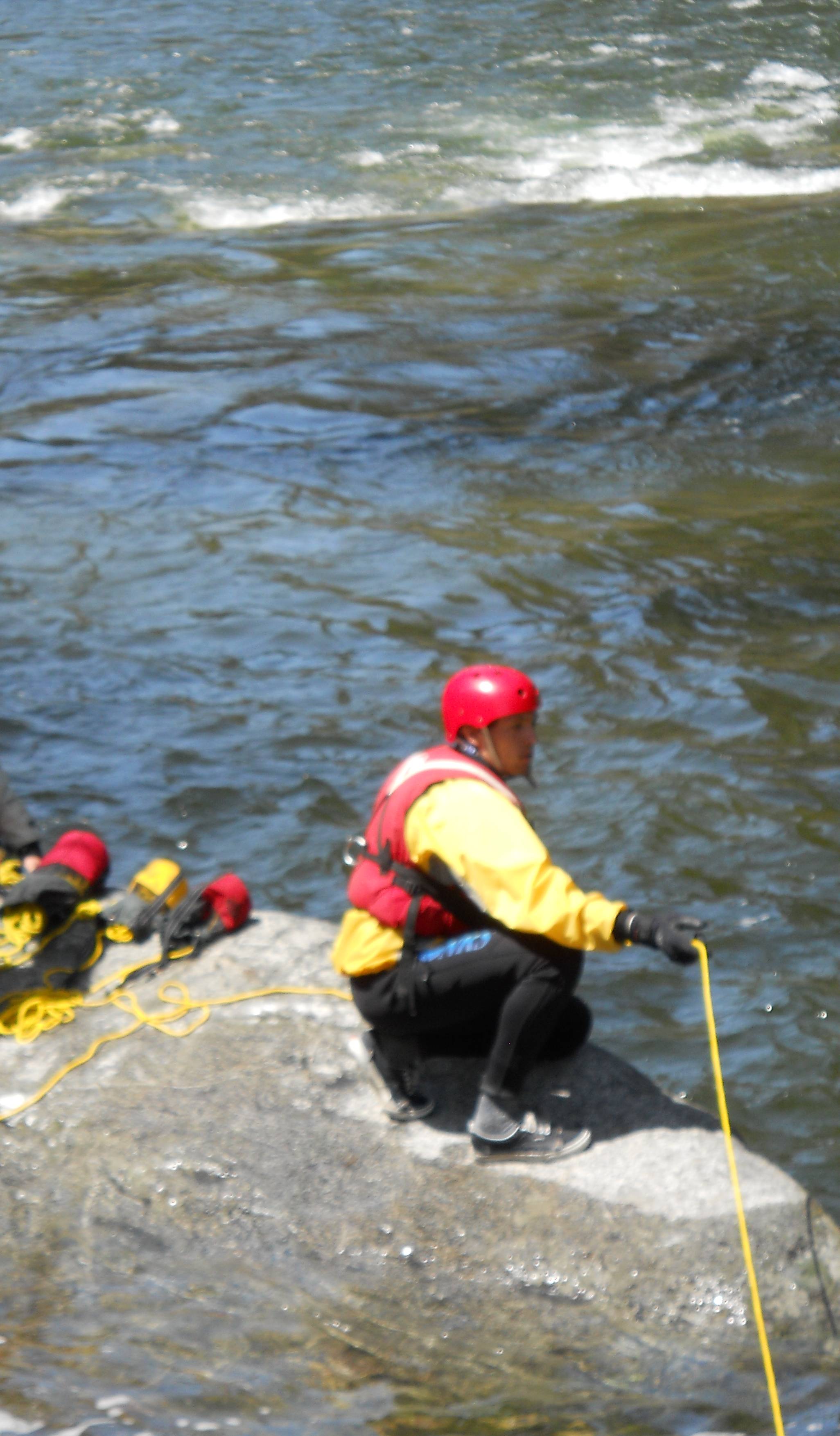
- swiftwater rescue course on the salt river 2010

Hey out there. Even though winter is closing in, and your throwbags are hanging up to dry, We thought a little refresher on the finer points of throwbagging would be useful. For those of you about to start a season of winter boating, you may find this useful too.
Here are some of the essentials of effective throwbagging in swiftwater:
- Practice – Train with the bag you that you take with you, and be accurate at 30-45ft. Aim for the bag to go directly over the victim’s head. Attempting to lead in front or behind the swimmer varies with the current and can lead to a miss. Aim to hit ’em.
- Communicate – Reach the victim with your voice before you reach them with your throwbag. Get the attention of the victim(s) and the other rescuers on shore before you throw a bag. Be cautious deploying a bag to a swimmer that doesn’t know its coming.
- Location – Pick a good spot to throw from; one that is stable and which will allow you to pendulum the victim to shore in a good spot (eddy, etc). Remember to deploy a bag where a swimmer can actually grab and hold onto the rope (not it the middle of a big drop).
- Reduce tension – Have, maintain, and give slack so that you don’t get pulled in by force of the current on the victim, and so that the victim has an easier time holding on. Remember, don’t let go of the rope!
- Coil Toss – For multiple or consecutive throws, deploying coils is often a faster way to get your rope back into the water. Keep the coils (loops) somewhere between 12-18 inches. The less you move the coils in your hand, the less likely they are to tangle. Try butterfly coils (alternating loops to each side of your palm). Don’t forget that when your are starting a coil throw, you have to begin coiling from one end of the rope (not the middle).
- Think outside the box. The victims life is in your hands. Don’t make things worse! Be dynamic as a belayer. Sometimes you’re going to have to move with the victim as they flow downstream. Get to a good spot, and consider using a body belay or some other source of friction to help against the force of the current.
- Know your throw. Pick a type of toss and get good at it; underhand, overhand, football toss, side arm. When using the underhand throw grab a fist-full of the open bag, not just between your thumb and forefinger.
- Practice! Practice! Practice! If you need some motivation, come join us for a Swiftwater Rescue Class!
Remember, a deployed throw bag is a line in the water and is dangerous. Choose wisely when you deploy a bag and make sure you’ve covered your bases. That being said, a throw bag is one of the most useful tools that you take with you on the water. It has numerous applications and can be a great asset in a rescue. Good Luck out there.
-Zach Byars 11.15.2011